













The platforms changed the rules this year. The brands still running 2022 playbooks are quietly bleeding budget. Here’s what actually shifted, what the new Meta updates mean for your ROAS, and how to win in an AI-first ad world.
If you’ve felt like your ad accounts have a mind of their own lately — campaigns that re-optimise themselves overnight, “recommendations” you didn’t ask for, settings that switch back on after you turn them off — you’re not imagining it. In 2026, performance marketing stopped being about who could pull the most levers manually. It became about who feeds the machine the best inputs.
That’s not a slogan. Both Meta and Google have publicly committed to a future where you hand the platform a goal and a budget, and AI does the targeting, bidding, placement, and increasingly the creative itself. Meta has openly stated it expects to offer fully AI-automated campaigns — provide a business URL and a budget, and its systems handle the rest — by the end of 2026. The pieces are already shipping.
For brands chasing profitable growth, this is either the best or the worst thing to happen to your ad spend. The difference comes down to how you adapt. Let’s break it down.
The big shift: from operator to director
For a decade, the edge in paid media belonged to whoever could micro-manage best — tighter audiences, smarter bid adjustments, endless ad-set splitting. In 2026, the algorithms do that better than any human can, in real time, across billions of signals.
Meta’s consolidated AI model (internally “Lattice”) drove a reported 12% lift in ad quality, and its incremental attribution system delivered around a 24% increase in incremental conversions. Google’s message at Marketing Live 2026 was blunt: stop micro-managing creative variations and obsess over the quality of your inputs instead. Their VP put it plainly — AI is a force-multiplier of the data you give it. Feed it fragmented signals and you get fragmented results.
So the job changed. You’re no longer the operator pushing buttons. You’re the director — setting the goal, supplying clean data and strong creative, and judging the output. The brands winning in 2026 made that shift early. The ones still “optimising bids manually” are being quietly out-performed by their own competitors’ algorithms.
What’s new on Meta in 2026 (the updates that matter)
Meta has been the most aggressive platform of all. Here’s what actually changed this year, and why each one affects your bottom line:
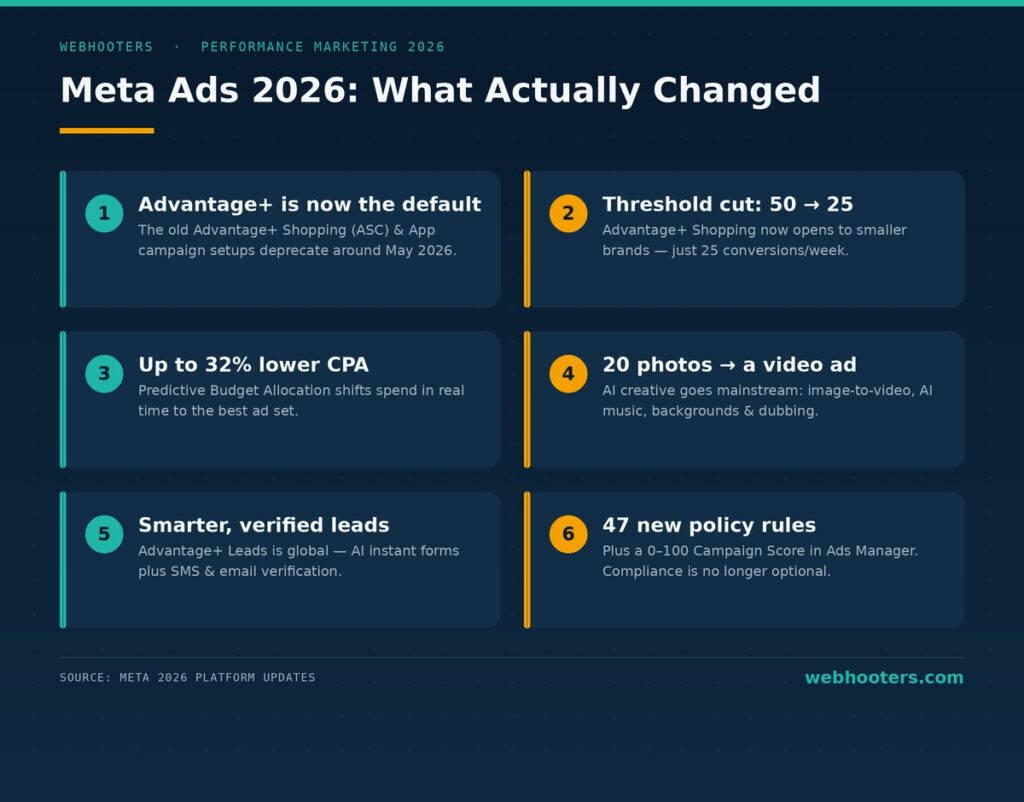
Advantage+ is now the default — and the only road forward. New campaigns now open with Advantage+ automation switched on by default. More importantly, Meta is deprecating the older Advantage+ Shopping (ASC) and App (AAC) campaign creation paths, with the cutoff landing around 19 May 2026. Translation: the manual, fragmented setups many advertisers still rely on are on a clock. If your workflows depend on the old structure, they need migrating now.
The barrier to entry just dropped. The conversion threshold to qualify for Advantage+ Shopping fell from 50 to 25 conversions per week. That opens AI-driven shopping campaigns to a much wider range of smaller and mid-size ecommerce brands that previously couldn’t meet the minimum — a genuine unlock for growing D2C businesses.
Predictive Budget Allocation. Instead of spreading budget evenly across ad sets, Meta now dynamically shifts spend in real time toward whichever ad set has the highest predicted conversion probability. Done right, advertisers who consolidated fragmented campaign structures have seen CPA reductions of up to 32%.
Lead-gen got a serious upgrade. Advantage+ Leads Campaigns are now global, with AI-driven instant forms, new lead-verification tools (SMS and work-email verification, with address verification in testing), and “Chat with your leads on Messenger” for instant engagement. For service businesses, edtech, and B2B, this is a meaningful jump in lead quality, not just volume.
Creative is now half-automated. Meta’s Image-to-Video tool turns up to 20 product photos into polished, multi-scene video ads — no production crew required. Add AI-generated background scenes, AI music matched to a video’s emotional tone, AI dubbing, and persona-based image generation (part of the 11 AI tools unveiled at Cannes Lions 2025 and rolling out through 2026), and the cost of producing ad variations has collapsed.
New scores, new controls, new rules. A Campaign/Opportunity Score (0–100) now sits in Ads Manager, grading how closely you follow Meta’s recommended setup. “Value Rules” hand back a little control — you can tell Meta to bid more for specific high-value segments without disabling automation entirely. And Meta introduced 47 new advertising policy rules in early 2026, several carrying real account-suspension risk if ignored. Compliance is no longer optional housekeeping.
One honest caveat: more automation isn’t automatically more profit. Advertisers have reported surreal AI-generated visuals, settings that silently re-enable themselves, and time lost correcting the machine’s mistakes. The automation is powerful — but it still needs a skilled hand on the wheel.
It’s not just Meta: the wider 2026 picture
Google’s stance is the same. At Google Marketing Live 2026 the headline was “Google search is AI search” — AI Mode is turning quick lookups into longer, exploratory sessions, Performance Max is expanding across all inventory, and new lead-gen ad types in AI Mode are rolling out for education, automotive, and real estate. The common thread across both giants: first-party data is now your single most valuable asset.
With browser pixels increasingly unreliable and privacy rules tightening, the old tracking stack is crumbling. The winners in 2026 are building server-side tagging, consent-mode measurement, email/SMS opt-in programs, loyalty data, and clean customer lists fed back into Meta and Google. Reports peg first-party-data’s contribution to ad revenue outcomes growing dramatically year over year. And last-click attribution? It’s effectively dead — rewarding only the final touch while ignoring the journey that actually drove the sale.
How to actually get results in 2026
The platforms handed you a more powerful engine. Here’s how to make it pay:
- Feed the machine clean data. Implement server-side tracking and conversions API, import offline conversions, and connect your CRM. AI bidding is only as smart as the signals you give it. This is the highest-leverage thing you can do this year — full stop.
- Make creative your new targeting. Since the algorithm now handles audiences, your creative is your differentiation. Test angles, hooks, and formats relentlessly — brands testing creative systematically have lifted conversion rates 2–3X without touching their audiences. Lead with vertical 9:16 video as the primary format.
- Consolidate, don’t fragment. The old habit of splitting into dozens of tiny ad sets now starves the algorithm of data. Consolidate into broader Advantage+ structures with 5+ strong creatives and let the system learn — that’s where the up-to-32% CPA gains come from.
- Guide the AI, don’t fight it. Use Value Rules to protect high-margin segments, set clear conversion goals, and review the Campaign Score — but resist micro-managing every setting. “Set and forget,” though, is equally a mistake. Active oversight beats both extremes.
- Measure profit, not vanity. Track ROAS against your actual margin, CAC, AOV, and lifetime value — not clicks and impressions. Build measurement around incrementality and full-funnel attribution, not last click.
- Own the retention engine. Acquisition wins the first sale; retention is where the profit lives. WhatsApp flows, abandoned-cart recovery, and repeat-buyer campaigns turn one-time orders into compounding revenue — and feed richer first-party data back into your ads.
How Webhooters improves your performance marketing
Here’s the uncomfortable truth about an AI-first ad world: the platforms have made it easier to spend money and harder to spend it profitably. Anyone can switch on Advantage+. Far fewer know how to feed it the right inputs, read the signals honestly, and steer it toward margin instead of vanity metrics.
That’s exactly the gap Webhooters closes. As a ROAS-focused performance marketing agency, we don’t chase clicks — we engineer profit. Our full-funnel framework — Demand Creation → Revenue Capture → Profit Optimization → Retention & Lifetime Value — is built for precisely this new paradigm:
- We engineer your data foundation — server-side tracking, clean conversion signals, and first-party data activation so the AI optimises toward your customers, not lookalikes of the wrong ones.
- We win on creative — strategy, UGC direction, and rapid testing, because in 2026 creative is the real targeting lever.
- We steer the automation — Advantage+ structured correctly, Value Rules protecting your margins, campaign consolidation done right, and a human watching the AI so its “mistakes” never cost you a fortune.
- We report what matters — revenue, ROAS, and CAC, with transparent insight you can act on. No black boxes, no vanity dashboards.
- We build retention — WhatsApp and email systems that lift repeat purchases and compound your returns.
It’s the same approach that helped a premium D2C brand achieve 10X Google Ads revenue growth and a 5X blended ROAS on Meta — consistent, month after month.
The algorithms got smarter in 2026. The advertisers who pair that intelligence with sharp strategy, clean data, and accountable execution are the ones pulling ahead. The rest are funding their competitors’ learning curve.
Ready to make 2026 your most profitable year on paid media?
Get a free ROAS audit of your Meta and Google ads. We’ll show you exactly where your budget is leaking and your single biggest growth opportunity for the next 30 days — yours to keep, whether we work together or not.
Meta has made Advantage+ automation the default for new campaigns and is deprecating the older Advantage+ Shopping (ASC) and App (AAC) creation paths around May 2026. The conversion threshold for Advantage+ Shopping dropped from 50 to 25 per week, Predictive Budget Allocation now shifts spend in real time, lead-gen campaigns gained AI instant forms and verification, and a wave of AI creative tools (image-to-video, AI music, background generation) rolled out. Meta also added 47 new ad policy rules in early 2026.
Not entirely, but the platform is steadily removing manual options. With Advantage+ set as the default and older campaign types being phased out, advertisers who depend on legacy manual setups need to migrate their workflows. The smart move is to learn to steer the automation rather than resist it.
No — it changes the job. AI now handles bidding, targeting, and much of creative production, so the human role shifts from operating campaigns to directing them: supplying clean first-party data, strong creative, clear value rules, and honest judgement of results. AI is a multiplier of input quality, not a substitute for strategy.
With browser pixels increasingly unreliable and privacy rules tightening, the platforms’ AI needs clean signals to optimise well. Server-side tracking, conversions API, CRM integration, and email/SMS opt-in data have become the foundation of profitable campaigns. The better your data inputs, the smarter the automation performs.
Feed it clean conversion data, consolidate rather than fragment your campaigns, launch with at least five strong creatives (vertical video first), use Value Rules to protect high-margin segments, and review the Campaign Score — but keep a human watching for AI mistakes. “Set and forget” is not a strategy.
Profit-tied metrics: ROAS against your actual margin, customer acquisition cost (CAC), average order value (AOV), and lifetime value (LTV). Last-click attribution is effectively obsolete — measure incrementality and the full funnel instead of just the final click.
The platforms made it easier to spend money and harder to spend it profitably. A ROAS-focused agency like Webhooters engineers the data foundation, wins on creative testing, steers the automation correctly, reports on revenue rather than vanity metrics, and builds retention systems — turning Meta and Google’s AI into profit instead of wasted budget.